

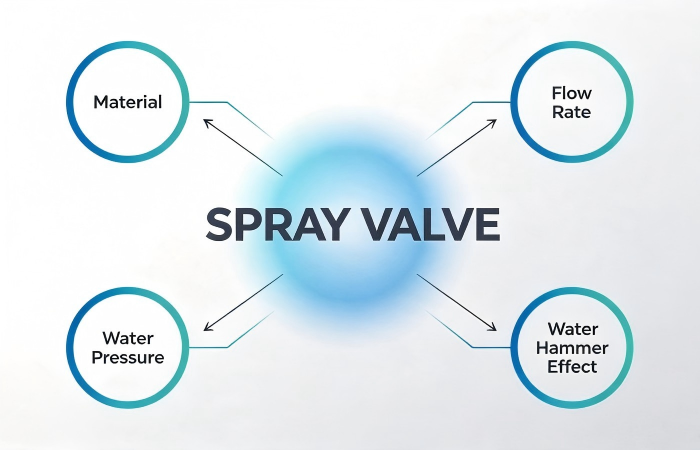
A spray valve is opened and closed repeatedly throughout the day. When choosing a spray valve, many people focus on material, flow rate, and water pressure, but often overlook the water hammer that occurs when water flow is stopped rapidly.Although water hammer occurs within the plumbing system, it can create repeated pressure surges that affect the internal components of the spray valve and the water supply system. For commercial kitchens with frequent daily use, controlling water hammer is therefore an important factor in long-term spray valve durability.
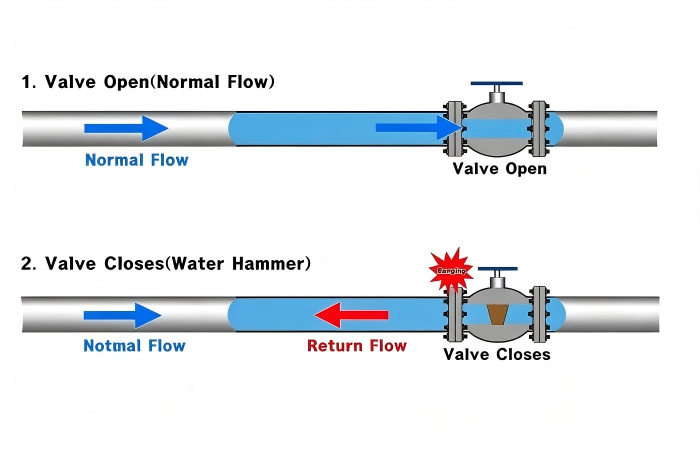
Water flowing through a pipe has inertia. When a spray valve is closed quickly, the moving water cannot stop instantly. This creates a short pressure surge that travels through the piping system. This phenomenon is known as water hammer.Simply put:
Fast-moving water → Spray valve closes suddenly → Water flow slows rapidly → Pressure fluctuates suddenly → Pressure impact occurs
The higher the water velocity and the more abruptly the flow is stopped, the more noticeable the pressure impact is likely to be.
Water hammer is not necessarily a single, obvious “impact.” Instead, repeated opening and closing of the spray valve can create repeated pressure fluctuations.In a commercial kitchen, a spray valve may be operated many times a day. If each shutoff generates a significant pressure surge, the cumulative effect can increase the load on the internal components of the spray valve and the water supply system.It can be simply understood as follows:
No. | Effect of Water Hammer | Potential Impact |
1 | Sudden pressure increase | Increases pressure on internal components |
2 | Repeated pressure fluctuations | Increases the workload on the valve body, stem, and seals |
3 | Pressure waves travel through the piping | Increases the impact on fittings and pipes |
4 | Frequent opening and closing over time | May affect overall service life |
Therefore, spray valve durability depends not only on what materials are used, but also on how pressure impact caused by water flow is controlled.
Some traditional spray valves use a relatively direct shutoff mechanism. When the user quickly releases the trigger, the water flow is cut off within a short period of time.
This means:
The water is still moving, but the flow is suddenly stopped.
When the inertia of the moving water cannot be released quickly enough, a noticeable pressure surge can occur.For occasional use, the effect may not be obvious. In high-frequency, demanding environments such as commercial kitchens, however, repeated pressure surges deserve greater attention.So when choosing a spray valve, don't just ask:
“Is the water pressure strong enough?”
Also ask:
“How does the spray valve manage the pressure impact when the water flow is shut off?”
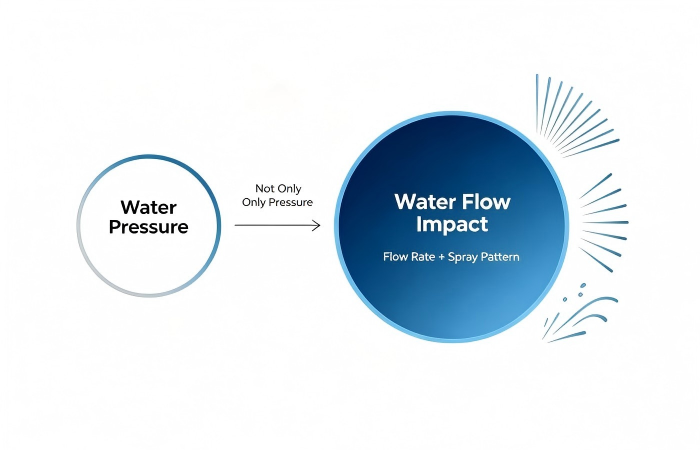
Water pressure determines cleaning performance, while pressure changes when the water flow is shut off can affect long-term usability and durability.Therefore, when evaluating a spray valve, it is worth looking beyond basic water flow performance and considering:
· Water pressure
· Operating force
· Internal structure
· Water hammer control
· Material durability
For commercial kitchens in particular, frequent use means that even small pressure surges can occur repeatedly throughout the day.Water hammer control may not be the first thing that comes to mind when selecting a spray valve, but it is an important factor to consider for long-term performance.

To address the pressure impact generated by frequent opening and closing, the Bestware spray valve uses a hydraulic cushioning structure.When the water flow is shut off, the hydraulic cushioning structure helps absorb changes in water flow and reduce the impact caused by sudden shutoff. This helps to:
· Reduce water hammer
· Reduce water flow impact
· Relieve pressure on internal components
· Help protect the kitchen water supply system
The hydraulic cushioning structure also improves the operating feel. Compared with traditional spray valves, the Bestware spray valve requires approximately 75% less operating force, making frequent operation easier.
The value of a spray valve is not simply its ability to deliver powerful water flow.For commercial kitchens that require long-term, high-frequency use, it is also important to consider:
No. | What to Consider | Impact |
1 | Water flow performance | Determines cleaning efficiency |
2 | Operating force | Affects long-term user comfort |
3 | Water hammer control | Reduces pressure impact when the water flow is shut off |
4 | Internal structure | Affects long-term stability |
5 | Materials | Affect corrosion resistance and service life |
A good spray valve should not only deliver powerful water flow, but also shut off smoothly and under control.
Spray valve durability is not determined solely by external materials or water pressure.In high-frequency applications, the pressure impact generated every time the water flow is shut off quickly also deserves attention.The Bestware spray valve uses a hydraulic cushioning structure to reduce water hammer and water flow impact. While maintaining effective cleaning performance, it helps provide better long-term protection for both the spray valve and the water supply system.